From the Centre for Research & Education on Violence Against Women and Children Learning Network:
In Canada, disabled people experience violent victimization at nearly three times the rate of abled people. Disabled women are far more likely to experience all forms of intimate partner violence (IPV), including physical, sexual, emotional, and financial abuse, regardless of disability type. Despite this reality, the disabled community is often excluded from gender-based violence (GBV) services, policy and prevention strategies. This exclusion is not accidental, it is an intrinsic part of ableism: a system of oppression that maintains abled people’s power over disabled people.
This Backgrounder focuses on disabled wisdom and innovation, not as mere inspiration, but as essential infrastructure for justice work. Disability Justice (DJ) is a movement and a framework that positions disability as a political and collective experience shaped by systems of oppression and generations of resistance.
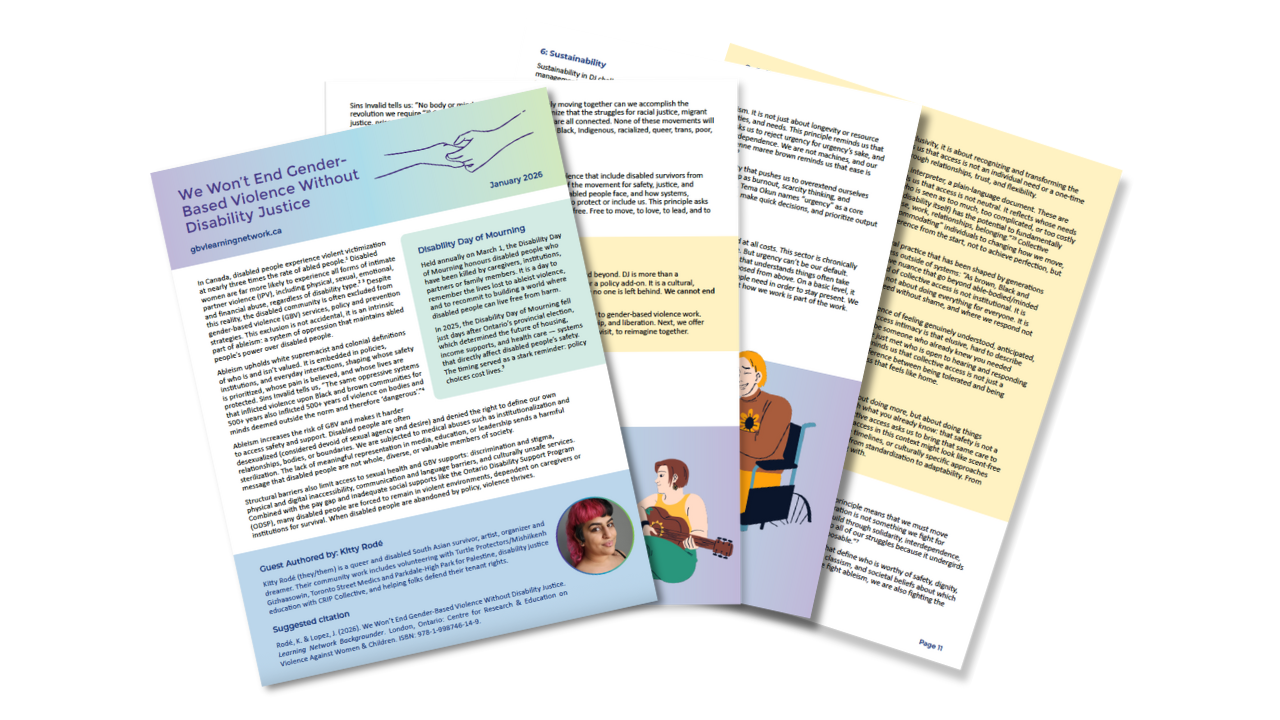
Access the full Backgrounder document here: We Won’t End Gender-Based Violence Without Disability Justice
What is Disability Justice?
DJ is a movement and a framework that examines how disability and ableism connect to all forms of oppression. It centers the lives and leadership of disabled Black, Indigenous and other people of colour (POC), as well as disabled queer, trans and Two-Spirit people with the understanding that our liberation will liberate the bodies and minds of all people. As Aurora Levins Morales writes, “What our bodies require in order to thrive, is what the world requires.” DJ moves us towards community care, transformed systems, and interdependence over independence, all of which are essential for ending GBV.
Resources:
- My Body Doesn’t Oppress Me, Society Does https://youtu.be/7r0MiGWQY2g
- The Unfit in Canada: A History of Disability Rights and Justice https://www.djno.ca/dj-history
- Addressing Sexual Violence and Promoting the Sexual Rights of Women Labelled with Intellectual Disabilities https://www.gbvlearningnetwork.ca/our-work/issuebased_newsletters/issue-41/index.html
Access the full Backgrounder document here: We Won’t End Gender-Based Violence Without Disability Justice
About this Backgrounder:
This Backgrounder is guest authored Kitty Rodé (they/them) is a queer and disabled South Asian survivor, artist, organizer and dreamer. Their community work includes volunteering with Turtle Protectors / Mishiikenh Gizhaasowin, Toronto Street Medics and Parkdale-High Park for Palestine, disability justice education with CRIP Collective, and helping folks defend their tenant rights.
Suggested Citation: Rodé, K. & Lopez, J. (2026). We Won’t End Gender-Based Violence Without Disability Justice. Learning Network Backgrounder. London, Ontario: Centre for Research & Education on Violence Against Women & Children. ISBN: 978-1-998746-14-9.




Comments are closed