November is Woman Abuse Prevention Month, which includes the 16 Days of Activism against Gender-Based Violence, a global campaign calling for an end to gender-based violence. It begins on November 25th, the International Day for the Elimination of Violence Against Women, includes The National Day of Remembrance and Action on Violence Against Women on December 6th, and ends on December 10th: Human Rights Day.
For 2026, our 16 Days campaign is focused on recognizing the work and efforts rooted in the history of activism at the NOWC, while seeing the growth that continues to push and advocate for change in present day and beyond. Today is Day #3 : Understanding GBV in Northwestern Ontario.
From 2019 to 2023, the Analysis to Action on Gender-Based Violence (AAGBV) Project at the NOWC aimed to enhance the systemic advocacy work being done in Thunder Bay and surrounding areas to improve the status of all women. One aspect of this was raising public awareness about what makes our district unique, and how it compounds the issue of GBV and justice for survivors & victims.
WHY IT MATTERS
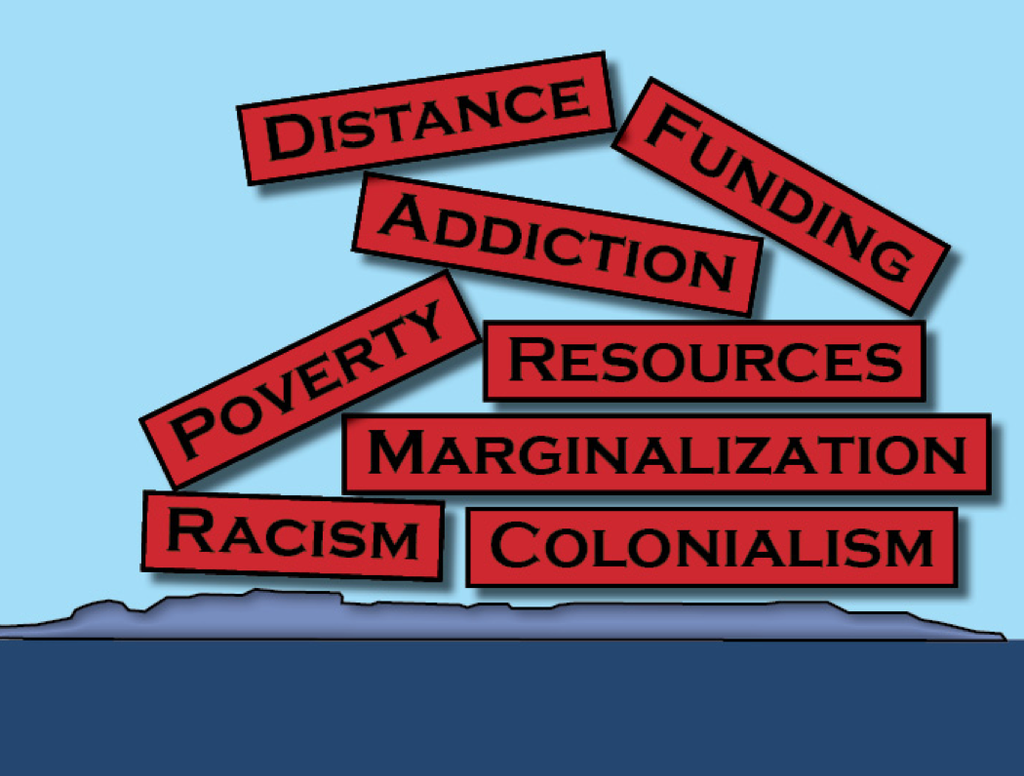
DISTANCE
The physical geography and sparse population of Northwestern Ontario are significant factors interfering with the systemic response to gender-based violence within the justice system. The region of Northwestern Ontario encompasses almost half of Ontario, but is home to just 1.7% of Ontario’s total population.
Residents of small, isolated communities are often deterred from reporting gender-based violence due to their remoteness and close community ties; they may also fear racist responses, criminalization of community members and potential ostracization from family and their home community. Most small communities do not have shelter or victim services and many do not have police forces. Exclusion and restraining orders can rarely be enforced in small, isolated communities.
RESOURCES
The Ontario Court of Justice divides the province into seven regions, each with a regional senior judge and Justice of the Peace. The Northwest region encompasses most of Northwestern Ontario – roughly the equal land area of the other six regions combined.
Only a few urban centres have courthouses and legal staff – other communities must access justice by travelling long distances to these centres or via satellite services or online proceedings. Community resources can also be more difficult to access in Northwestern Ontario due to its geography. Many roles, such as medical practitioners, social workers or addiction specialists, work on rotating schedules out of satellite offices.
ADDICTION
High rates of alcoholism and drug abuse in the region contribute to higher rates of gender-based violence.
Thunder Bay has the highest per-capita opioid overdose death rate in Ontario, remaining more than five times the provincial average in recent reporting.
There exists a gap in rehabilitative services, as well as long distances to travel to access those that are in place. Services are especially lacking for women with addictions, with a very limited number of gender specific detox and rehabilitative beds compared to those intended for male patients.
POVERTY
Distance and access to resources compounds poverty in Northwestern Ontario, especially in remote communities. Women living in poverty are particularly vulnerable, as the lack of financial resources is a key determinant influencing a person’s decision to leave violent situations.
Those experiencing gender-based violence and poverty have significant barriers in leaving the perpetrator, including a lack of income, inadequate housing and childcare, in addition to lack of access to justice to address custody, child support and division of assets.
MARGINALIZATION
Northwestern Ontario is home to large segments of marginalized peoples, including Indigenous people, low-income households and the precariously housed.
The Thunder Bay and Kenora regions have high levels of homelessness, as well as many people in transit to and from northern communities; this can make it difficult finding the accused, victims and witnesses for trial. As a consequence, charges are often withdrawn if no witnesses or complainants come forward or attend court.
FUNDING
Most government services, including social and legal services, are funded based on population. Compared to metropolitan regions in Southern Ontario, the North has a relatively small population spread over great distances, with no secure or publicly-funded ground transportation network connecting them. Tax revenues are generally too small for municipalities to cover a full suite of public services.
Public services are often delivered through small satellite offices or by contracting with local businesses or municipalities. This results in fragmentation of services, including access to justice and victim supports.
RACISM
In 2015, Thunder Bay reported more hate crimes than any other city in Canada on a per capita basis. The city has had one of the highest per capita homicide rates of any Canadian city with a population of over 100,000 since 2015 and is widely referred to as the murder capital, or hate crime capital, of Canada.
There is an understandable high level of distrust of police and the justice system by marginalized communities, affecting willingness of survivors and witnesses to follow through with the court process, or even report instances of gender-based violence to police in the first place.
Indigenous people are overrepresented in Canada’s criminal justice system as both victims and as people accused or convicted of crime. In 2017/2018, Indigenous adults accounted for 30% of admissions to provincial/territorial custody, while representing approximately 4% of the Canadian adult population. In comparison, ten years ago, 21% of admissions to provincial/territorial custody were Indigenous.
COLONIZATION
Northwestern Ontario is comprised of the traditional territory of a large number of First Nations. As a result, the area is home to a larger proportion of Indigenous people than most of urban and suburban Canada. Since Europeans first came to North America, Canadian institutions such as police, courts and child welfare agencies have been used as instruments of colonization to oppress and steal sovereignty from First Nations people.
The Robinson-Superior Treaty (signed in 1850) concerns the north shore of Lake Superior. The Crown’s main motivation for entering into the Robinson Treaties was to open up the land for mineral resource exploration. Miners has already been developing mines in the area, forcing First Nations to petition for compensation for the already-affected lands. Annuities to the First Nations’ members have not changed since 1874, at $4 per member a year. In December 2019, Sudbury Superior Court Justice Patricia Hennessy ruled that the First Nations should have received annuities increases since the treaty signing in 1850.
ACTION
At the NOWC, we believe survivors of gender-based and intimate partner violence. Our Gender-Based Violence Navigation Advocate provides support for women who are experiencing or are at risk of experiencing physical and/or sexual violence or coercive control by a partner, family member or acquaintance. Women who are navigating various court systems may also access court advocacy.
We can help by:
- Ensuring that women who are experiencing or at high risk of gender-based violence have access to ongoing and appropriate support and referrals
- Coordinating with Violence Against Women service providers to ensure that critical information is shared
- Assisting with preparing for court
- Ensuring coordination between various legal sectors (criminal, family, immigration etc.)
- Providing court accompaniment and emotional support
This service is intended to enhance the effectiveness of the existing VAW response, not duplicate or replace it. For more information or to make a referral, contact Caro: [email protected] | Phone: (807) 935-8042
RESOURCES
- Analysis to Action on Gender-Based Violence. Northwestern Ontario Women’s Centre. 2023
- Supporting Rural Women Leaving Abusive Relationships – A webinar from Luke’s Place and CLEO (Recorded on June 4, 2020) with Pamela Cross
- Roadmap for the National Action Plan on Violence Against Women and Gender-Based Violence
- Paling, E. (2018, March 8). For small-town Canadians, sex assault Is a ‘normal’ part of life: Survivor.




Comments are closed