November is Woman Abuse Prevention Month, which includes the 16 Days of Activism against Gender-Based Violence, a global campaign calling for an end to gender-based violence. It begins on November 25th, the International Day for the Elimination of Violence Against Women, includes The National Day of Remembrance and Action on Violence Against Women on December 6th, and ends on December 10th: Human Rights Day.
For 2026, our 16 Days campaign is focused on recognizing the work and efforts rooted in the history of activism at the NOWC, while seeing the growth that continues to push and advocate for change in present day and beyond. Today is Day #4: Put women’s safety at the centre of the systemic response to GBV & IPV
Centring Survivor safety in a systemic response to GBV
In 2021, the NOWC began the High Risk Gender Based Violence Navigation Project: a feminist response and recovery from the current impacts of COVID19 through systemic change. The Northwestern Ontario Women’s Centre (NOWC) achieved this by operationalizing the implementation of the High Risk Navigation Protocol and promoting its use as a central tool among service providers to relocate the safety of women, trans, and nonbinary people and their children at the front end of the systemic response to Gender Based Violence (GBV). A key aim of this project was to put women’s safety at the centre of the systemic response to GBV & IPV
The Navigator’s report, “Women’s Safety at the Centre (of the Systemic Response to Gender Based Violence)” was created to summarize the findings of the 30-month project. The GBV Navigator and GBV Court advocate supported over 200 women and gender diverse folks from April 2021 to March 2024 who were experiencing intimate partner violence and/or sexual violence by. The support offered included: taking notes and preparing strategic questions with women; educating women about their rights in court; accompanying women to court events or legal appointments; and connecting women with appropriate supports and services in the community (i.e. housing, counselling, victim services)
Learn more about the past Gender-Based Violence Court Advocate work here
WHY IT MATTERS
Safety should be a right that is provided to survivors without a request for identification, verification or other eligibility criteria. The more doors that open to safe spaces for women and gender-diverse people, the better.
There are several systemic gaps identified in the project that continue to impact the safety of women and children, including:
CRIMINAL LEGAL SYSTEM
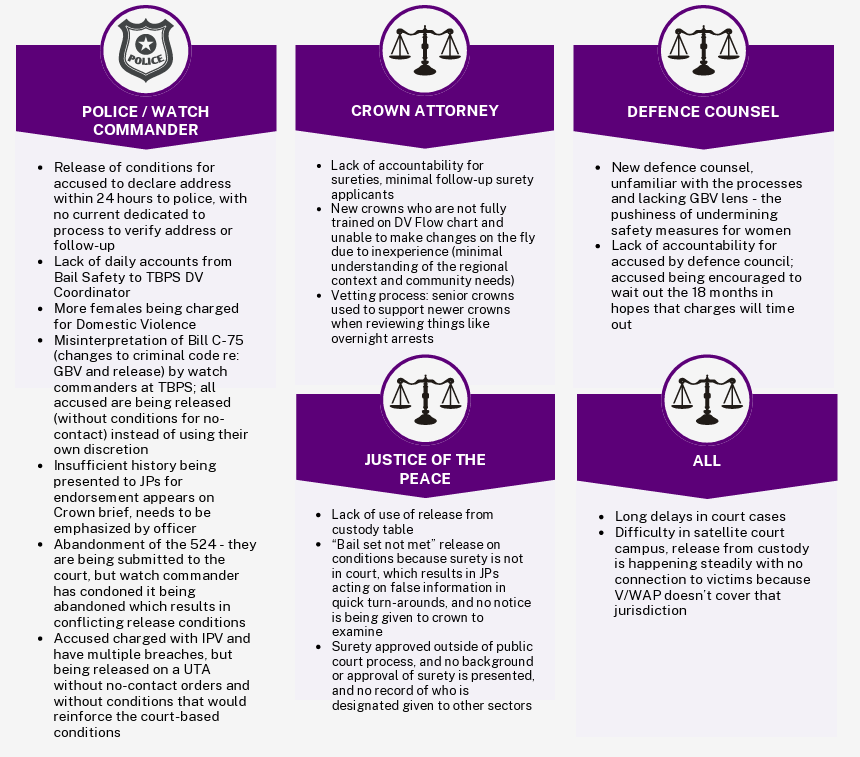
The NOWC participated in the Covid-19 VAW Task Force to highlight the systemic gaps and actions taken by local criminal legal system players. Each of the following gaps increases the risk of violence for women and children, while simultaneously decreasing sanctions and accountability for perpetrators of violence:
- Police: Watch Commander: release of conditions for accused to declare address within 24 hours to police, with no current dedicated to process to verify address or follow-up; lack of daily accounts from Bail Safety to TBPS DV Coordinator; more females being charged for Domestic Violence; misinterpretation of Bill C-75 (changes to criminal code re: GBV and release) by watch commanders at TBPS – all accused are being released (without conditions for nocontact) instead of using their own discretion; insufficient history being presented to JPs for endorsement appears on Crown brief, needs to be emphasized by officer; abandonment of the 524 – they are being submitted to the court, but watch commander has condoned it being abandoned which results in conflicting release conditions; and the Accused charged with IPV and have multiple breaches, but being released on a UTA without no-contact orders and without conditions that would reinforce the court-based conditions
- Crown Attorney: lack of accountability for sureties, minimal follow-up surety applicants; new crowns who are not fully trained on DV Flow chart and unable to make changes on the fly due to inexperience (minimal understanding of the regional context and community needs); and vetting process: senior crowns used to support newer crowns when reviewing things like overnight arrests
- Defence Counsel: new defence counsel, unfamiliar with the processes and lacking GBV lens – the pushiness of undermining safety measures for women; and a lack of accountability for accused by defence council; accused being encouraged to wait out the 18 months in hopes that charges will time out
- Justice of the Peace: lack of use of release from custody table; “bail set not met” release on conditions because surety is not in court, which results in JPs acting on false information in quick turn-arounds, and no notice is being given to crown to examine; and surety approved outside of public court process, and no background or approval of surety is presented, and no record of who is designated given to other sectors
- All criminal legal system players: long delays in court cases; and difficulty in satellite court campus, release from custody is happening steadily with no connection to victims because V/WAP doesn’t cover that jurisdiction
FAMILY COURT SYSTEM
The NOWC participated in Luke’s Place’s Ontario Family Law Court Watch project. This province wide project aimed to better understand the ways the family court system manages cases where there is intimate partner violence; throughout this project, the NOWC recruited and trained students and volunteers to observe family court matters at the Thunder Bay Courthouse. Our observations from this project, as well as our work directly with women navigating the family court system show us, that the family court system can be used to further harm women experiencing intimate partner violence.
Some of our observations include:
- There is an acute shortage of family law lawyers in Northwestern Ontario and family courts are experiencing significant backlogs
- Between April 2021 and March 2024, 68% of women we supported who were experiencing violence and navigating the family law system did not have a family law lawyer and/or did not know they needed a family law lawyer. Without access to a family law lawyer, women and children are at much greater risk of ongoing violence.
- Effects of family court on the survivor
- Can include: emotional abuse, weaponizing of previous and/or current mental health, fear, financial abuse, physical health issues, losing time with children, strained relationships with family and friends, re-victimizes survivors
- May create distrust with social agencies and the court system due to service providers having a lack of understanding on GBV/IPV
- Common forms of litigation abuse:
- Can include: changing legal counsel multiple times, not signing documents, insisting on meeting in person to exchange documents, and starting excessive and unnecessary motions
- Extending length of proceedings to increase legal fees, stress, anxiety etc.
- Making false reports to Child Protection Agencies Attacking the survivor’s credibility and their ability to parent
PUBLIC EDUCATION
There continues to be a strong need for consistent public education, training, advocacy, and other systemic efforts designed to make the link between women’s experience and the status of women in Canada. Throughout the project, there was a dramatic increase in women, community members, frontline workers, and legal professionals accessing our workshops and Family Law/ Legal Education Clinics.
ACTION
- Research alternative measures of accountability that are community-based and perpetrator-focused
- The GBV Navigation works directly with women who have experienced gender based violence and our court watch results clearly demonstrate the ways in which our systems (criminal court, family court, child welfare etc.) continue to silence, disregard, and further harm those who have already been subjected to abuse and violence; specifically, the criminal legal system prioritizes the perpetrator of violence, often compromising the safety of the women and children.




Comments are closed